
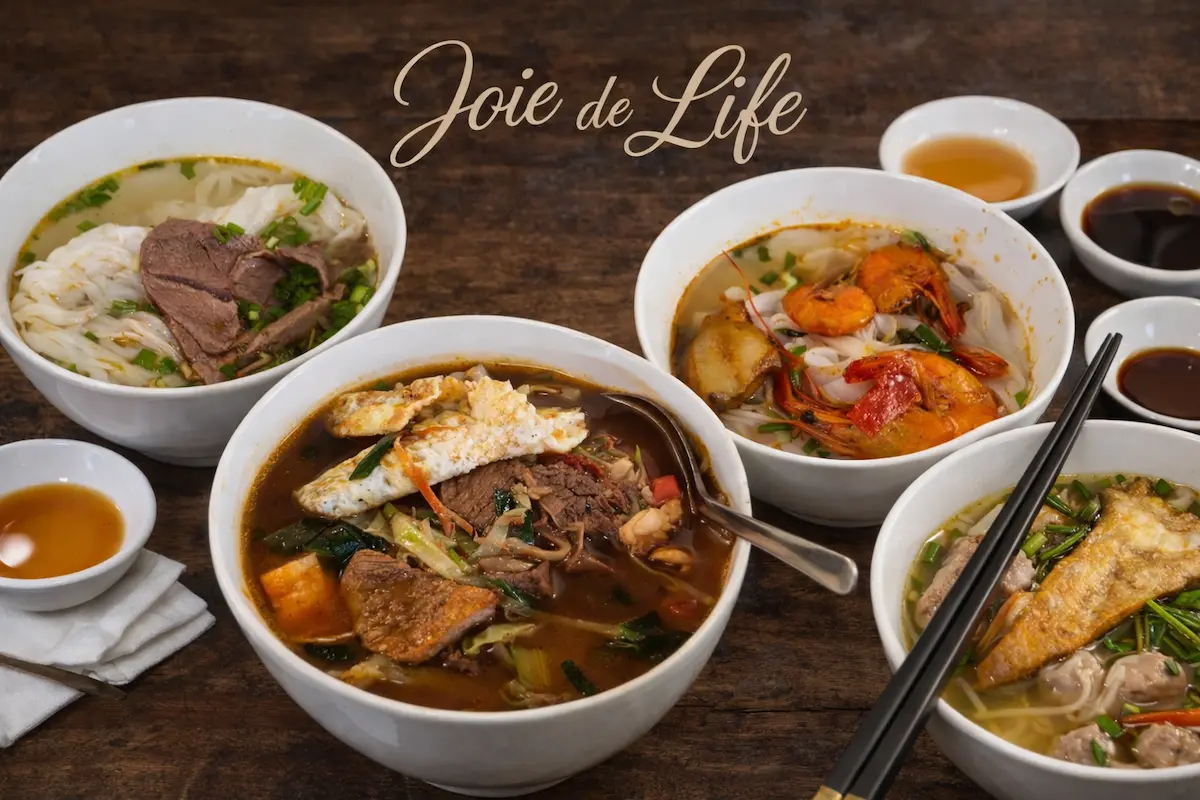
The Soul of Vietnam in a Bowl
Category: Food & Travel | Location: Vietnam
If Vietnam had a scent, it wouldn’t be motorbikes or tropical rain. It would be the smell of charred ginger, star anise, and simmering meat bones wafting through the humid morning air at 6:00 AM.
During our recent family trip through Vietnam—from the ancient streets of Hanoi down to the bustle of Saigon—I quickly learned that life here runs on two things: intense coffee (as we discussed in the last post!) and steaming bowls of Phở (pronounced essentially like “fuh?”—think of asking a question).
For me, finding my first proper bowl of pho wasn’t just about getting breakfast; it was about officially arriving in Vietnam. It is the national dish, the great equalizer, and quite possibly the world’s most perfect comfort food.
Today on Joie de Life, we are pulling up a tiny plastic stool on the sidewalk, dodging a few motorbikes, and diving deep into the magic broth that fuels a nation.
More Than Just Noodle Soup
To call pho just “noodle soup” feels like a disrespect. It’s like calling the Taj Mahal a nice building.
Pho is an obsession. It’s a craft that takes hours, sometimes days, to perfect. While the flat rice noodles (bánh phở) are important, and the thin slices of meat are delicious, any true pho lover knows that the real magic lies in the broth.
A great pho broth is a labor of love. It involves simmering meat bones (marrow bones, knuckles) for 12 to 24 hours to extract every ounce of flavor and collagen. But the secret weapon is the aromatics. Giant knobs of ginger and whole onions are charred over an open flame before being tossed into the pot, along with a sachem of spices that usually includes star anise, cinnamon, cloves, coriander seeds, and cardamom.
The result shouldn’t be heavy or greasy. It should be clear, unbelievably fragrant, savory, and possess a depth that touches your soul. It’s bone broth therapy before bone broth was cool.
A Tale of Two Bowls: The North vs. The South
This is crucial high-value info for anyone traveling to Vietnam, because pho is not the same everywhere you go. Having traveled from North to South, the difference was striking.
Northern Pho (Phở Bắc – Hanoi Style): The Purist This is where we started our journey. Northern pho is minimalist. It’s elegant. It’s all about the purity of the broth.
- The Broth: Clear, savory, and simpler.
- The Noodles: Often wider.
- The Garnishes: Very few. You’ll get lots of green onion and cilantro chopped on top, maybe some pickled garlic and chili on the side, and a lime wedge. That’s it. No jungle of herbs.
- The Vibe: It feels deeply traditional and focused.
Southern Pho (Phở Nam – Saigon Style): The Party Down south, the climate is hotter, and the food gets bolder and sweeter. Southern pho is vibrant and customizable.
- The Broth: Usually sweeter, slightly darker, and sometimes fattier.
- The Noodles: Generally thinner.
- The Garnishes: A veritable garden arrives on a separate plate: Thai basil, sawtooth herb (culantro), bean sprouts, and fresh chili slices.
- The Sauces: Hoisin sauce (tương đen) and Sriracha (tương ớt) are staple condiments on the table, used liberally.
Neither is “better.” It’s entirely a matter of preference. I found myself loving the austere, comforting purity of the Hanoi style on a cool morning, but craving the herbal punch of the Saigon style for lunch.


The Ritual: How to Eat Pho Like a Pro
Watching tourists approach their first bowl of pho can sometimes be painful for locals. There is a ritual to it, a respect for the chef’s work. Here is how to handle that steaming bowl without looking like a total rookie:
- The First Sip Protocol: Before you add anything—no lime, no chili, no sauce—take your spoon and taste the broth pure. Appreciate the hours of work that went into it.
- The Herb Tear: If you are in the South, tear up the basil and sawtooth herb to release their oils before dropping them in.
- The Heat Check: Be very, very careful with those little sliced chilies. They are assassins. Start with one or two slices.
- The Sauce Debate: Do you squeeze Hoisin and Sriracha directly into your broth? Purists scream “No!” claiming it ruins the broth’s balance. They suggest making a little dipping pool of mixed sauces in a side dish for your meat. However, look around—plenty of locals squeeze it right in. Do what makes your heart happy.
- The Slurp: Slurping is mandatory. It’s not rude; it’s practical. It introduces air to cool down the piping hot noodles and enhances the flavor. Get your face down near the bowl and slurp away.
Final Toast
Our best pho experiences weren’t in fancy restaurants. They were on street corners in the Old Quarter of Hanoi, sitting on stools so low our knees were near our ears, sharing table space with locals fueling up before work.
There is something profoundly communal about it. Everyone from CEOs to students sits shoulder-to-shoulder, united by the need for that restorative broth.
So, when you find yourself in Vietnam, Live the morning rush, Explore the side streets until you see the steam rising, Taste the broth before you season it, and let’s Toast to the masters who spend all night simmering bones so we can start our day right.

Leave a Reply